


Context: On April 10, the ten-day mission of the U.S. crew-carrying spacecraft Orion came to an end. It was the first human mission to the Moon in half a century, as well as the farthest manned mission in history. The Artemis II mission was the second phase of the U.S. lunar program. Through this program, the United States hopes to establish a permanent, autonomous lunar base in the future. Meanwhile, Russia celebrated the 65th anniversary of Yuri Gagarin’s flight, hosted Space Week, and announced that the next Russian lunar mission would be postponed from 2027 to 2032.
Andrei Mukavozchyk, the host of the CTV project Voprosy ot blondinok, questioned whether the Americans actually sent a spacecraft to the Moon.
“And who told you they are flying there — the Americans themselves? <...> In today’s technological age, artificial intelligence can generate such realistic deepfake images of Earth and the Moon that even your own mother couldn’t tell NASA’s backyard from the far side of the Moon,” he said on April 6, 2026.
The U.S. was not the only source to confirm the mission’s flight. NASA live-streamed the Orion mission to the Moon in real time.
The Canadian Space Agency published the mission diary separately because one of the crew members was a Canadian astronaut. Although it did not provide continuous broadcasting, the agency regularly posted mission updates.
There were also independent observers watching the spacecraft. In particular, amateur Canadian researcher Scott Tilley tracked the spacecraft’s signal with an antenna as it followed its trajectory from his home and published the results on X.
The Bochum Observatory in Germany also tracked the mission. Using a radio telescope, it recorded the signal from Orion in space and posted the data on YouTube in real time.
Additionally, an Italian astronomical laboratory used robotic telescopes to record the spacecraft’s movement. The images were taken from Italy one day apart, when the spacecraft was already hundreds of thousands of kilometers from Earth.
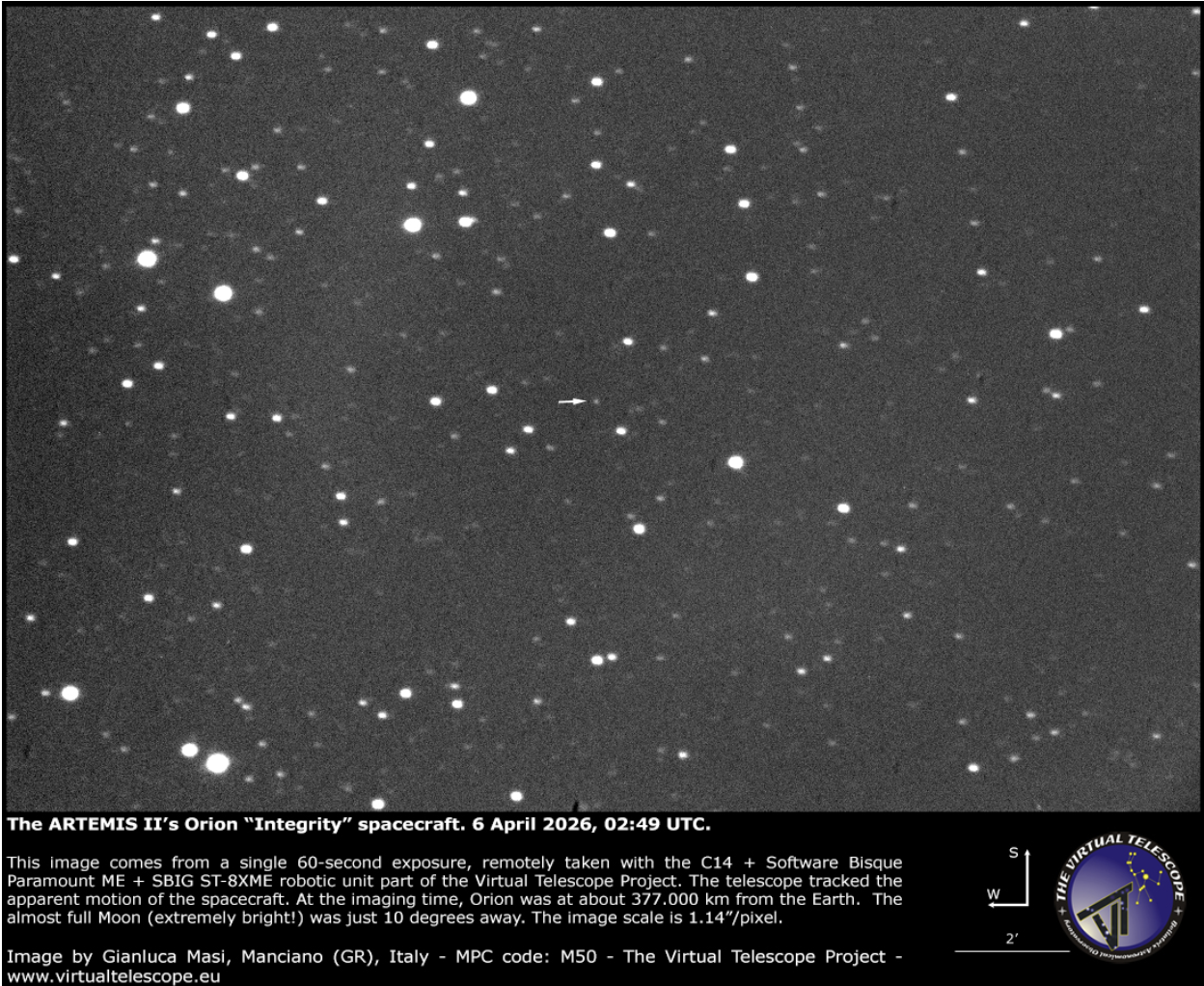
Source: The Virtual Telescope Project. The Orion spacecraft of the Artemis II mission. April 6, 2026.
Mukavozchyk continued, “By the way, girls. Why are they planning to land on the side of the Moon that can’t be seen from Earth? Maybe it’s so no one can see it?”
That contradicts the facts, too. The Artemis II mission did not include a landing. The spacecraft merely flew around the far side of the Moon and took images of its surface..
A landing is planned only for one of the upcoming missions, in two years, in 2028. The site selected is the Moon’s South Pole — an area on the boundary between the visible and shadowed parts of the satellite. All nine potential landing sites are either permanently or, for most of the time, in the visible zone. This is because direct radio communication with Earth is lost on the far side of the Moon. Stable communication with the crew is one of the key criteria for choosing a landing site.