


This investigation was conducted in collaboration with the Rabochy Ruсh initiative, with support from the Cyber Partisans.
Sensational headlines about the nationalization of Amkodor and the retirement of its former owner, which appeared in the media March 2025, proved far from reality. The Belarusian Investigative Center found that government-linked businessman Alexander Shackutin, who drove the holding company to the brink of collapse, retained a significant portion of the business and continues to profit from the Amkodor brand. Furthermore, he may regain his stakes in the companies that have come under state control. Meanwhile, the burden of repaying hundreds of millions of dollars in loans taken out for the company's development is being shifted to the Belarusian state budget.
Holding on to an empire
The latest chapter in the history of Belarusian industrial giant Amkodor began in the early 2000s. During this period, Alexander Shackutin and a partner began buying up shares in the private company. In 2012, his partner left the business, making Shackutin the majority owner with a controlling stake. Over the 25 years, he built his empire, creating new factories from scratch or acquiring state-owned ones, often at discounted prices.
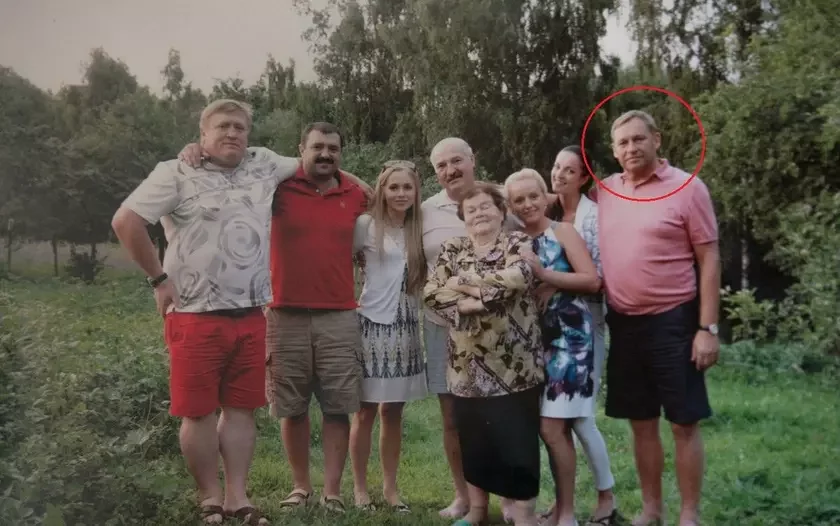
As his wealth grew, so did the businessman's political influence. Shackutin became a close friend to Aleksandr Lukashenko: he flew with him on the presidential plane [*] [*], attended family gatherings and fiercely defended the regime during the 2020 protests. The Belarusian leader publicly referred to him affectionately as Sasha. This close relationship is exactly why the EU sanctioned Shackutin in 2020 as an individual benefiting from Lukashenko's presidency. Therefore, it comes as no surprise that when Shackutin's empire began drowning in debt in the early 2020s, the state repeatedly came to his rescue [*] [*] [*] [*] [*] [*], and when things went from bad to worse, it bought out the debts of the businessman's company along with the loss-making asset. But even after losing the centerpiece of his empire, Shackutin continues to profit from Amkodor, as the holding company handed over to the state was just one part of his massive equipment manufacturing and sales business.
![[*]](/storage/page_blocks/March2026/119.png)
![[*]](/storage/page_blocks/March2026/213.png)
![[*]](/storage/page_blocks/March2026/35.png)
![[*]](/storage/page_blocks/March2026/43.png)
![[*]](/storage/page_blocks/March2026/53.png)
![[*]](/storage/page_blocks/March2026/63.png)
![[*]](/storage/page_blocks/March2026/76.png)
![[*]](/storage/page_blocks/March2026/86.png)
Amkodor is not merely a single large factory but a colossal holding company that, as of 2025, comprised 19 plants and a dozen other firms ensuring its smooth operation. The holding company's product line is vast, ranging from excavators, road rollers, logging harvesters and spare parts for a wide array of machinery to kitchen mixers, hair dryers, meat grinders, medical devices and even state decorations and medals. Amkodor's business operations span not only all of Belarus but also a dozen other countries, including Russia, Kazakhstan, Uzbekistan and even distant Bangladesh.

Source:
Rabochy Ruсh
The Amkodor holding company focused primarily on manufacturing machinery, while its satellite firms—also part of the businessman’s portfolio—specialized in supplying spare parts and finished-product sales. They were not formally part of the holding company, but without them, the main plants could have ground to a halt at any moment. These companies included Saleo-Kobrin, which produced hydraulic cylinders for most Amkodor machinery, and the Prodi factory, which manufactured plastic exterior and interior components for wheeled vehicles. This infrastructure also includes an extensive dealer network for selling Amkodor equipment in Russia. Because this empire was built over more than 20 years, the resulting ownership structure was complex and convoluted—allowing Alexander Shackutin to avoid losing all his assets at once.
Profiting from loss
Although Amkodor continued to launch new models and invest in new projects throughout the 2020s, its financial health steadily declined due to mounting debt for modernization and day-to-day operations. In 2022, the holding’s management company had approximately $200 million in debt. [*] That same year, a $45 million state loan taken out in 2016 came due, but only $500,000 was repaid; the company clearly lacked the funds to cover the balance. [*]
![[*]](/storage/page_blocks/March2026/103.png)
![[*]](/storage/page_blocks/March2026/1110.png)
The state itself helped the company repay its debt to the state. By a special decree from Lukashenko, and under the pretext of “stabilizing the financial condition” of the enterprise, Amkodor was granted a new $44.5 million loan from the state budget to pay off the remainder debt. The interest rate was cut from 7% to 5% annually—nearly half the rate of inflation—meaning the loan was provided on preferential terms. [*]
![[*]](/storage/page_blocks/March2026/127.png)
But this time, the loan came with protection for the state: shares of Amkodor JSC, the holding’s management company, served as collateral for the repayment. Under the agreement, if the company is unable to settle the debt by 2026, the holding company—comprising 29 firms with varying ownership stakes—will pass to state control. [*]
![[*]](/storage/page_blocks/March2026/133.png)
“This is a standard condition for a non-commercial loan. In effect, this loan should have been viewed as state support. The low interest rate and the terms—under which the state's stake in the authorized capital increases by that amount in the event of default—are classic conditions for providing aid to a company," said Siarhei Chaly, host of the Belarusian Investigative Center program "Chaly: Economics."
There was no need to wait until 2026. By 2024, the engineering giant reported a net profit of just 100,000 Belarusian rubles, or about $31,000. [*] [*] The total debt of the holding's enterprises rose by another third, exceeding 1 billion rubles, or approximately $310 million, with 167 million rubles, or about $51 million, already overdue. [*] Shackutin had no means to repay the debts—which in financial terms signals inevitable bankruptcy. In early 2025, the state moved to claim its shares, and the holding company was subsequently placed under external management. [*] [*] In a state governed by the rule of law, unintentionally driving a company into bankruptcy does not usually lead to criminal charges for the owner, but Belarus follows a different practice: prominent businessmen can be prosecuted for mismanaging their private property. Shackutin, however, was spared the authorities’ wrath. Instead, the state bought out Amkodor's debts from his tenure, along with the factories that carried them, at a valuation roughly 1.5 times their actual worth.
![[*]](/storage/page_blocks/March2026/143.png)
![[*]](/storage/page_blocks/March2026/153.png)
![[*]](/storage/page_blocks/March2026/163.png)
![[*]](/storage/page_blocks/March2026/173.png)
![[*]](/storage/page_blocks/March2026/184.png)

Source:
Rabochy Ruсh
Screenshot from the buyout text: Taking into account 63.9 million rubles in budget loan debt and 43.55 million rubles in authorized capital (adjusted for net asset value and negative exchange rate differences), this measure will result in a state stake in Amkodor JSC of approximately 97.2%.
But Shackutin did not walk away empty-handed. An analysis of his business empire’s ownership structure following the state takeover of the Amkodor holding shows that the businessman retained companies integrated into the production chain or involved in the sales and maintenance of Amkodor equipment. Of the 24 firms, Shackutin is the majority owner in 12, holds minority stakes in six, and is linked to the remaining six through family members. The shares of these companies were not used as collateral for the $44.5 million loan, meaning the state had no claim to them.
"This shows that Shackutin is a truly talented businessman. He structured the deal so masterfully that he comes out a winner even when he loses. This means that if the state, heaven forbid, actually works a miracle and rescues the company, he will still be the supplier of the key components and technological solutions it cannot function without. Essentially, he offloaded the loss-making core while keeping the parts of the enterprise that remain profit centers. That’s a brilliant strategy," Chaly explained.
Nationalizing the losses
The 2025 share transfer did not mark the end of the redistribution of Shackutin's empire. Early that year, he transferred his stakes in his Belarusian companies to his wife and son—a move that suggests an attempt to shield these assets from potential state financial claims. In October, the news outlet Nasha Niva reported on the businessman's detention, later clarifying that Shackutin spent three days in a pre-trial detention facility. A series of events followed that are difficult to dismiss as mere coincidence, suggesting that the state and Amkodor's new management were attempting to pressure the businessman.
In late October, Aliaksandr Yafimau, general director of the state holding company, issued an order prohibiting subordinate enterprises from settling accounts or repaying loans to 24 firms owned by or linked to Shackutin or his family. A month later, in November, Amkodor-Pinsk CJSC came under state control, the company's deputy director told the BIC in a phone conversation. The shares of Amkodor-Pinsk were not part of the collateral for the state loan, and the Shackutin family owned 73% of them. While the details of the deal are unknown, the state somehow gained control over one of the largest plants under the Amkodor brand that had remained in private hands following the split. Another month later, in December 2025, the businessman transferred part of his Russian dealer network to his wife, as he had previously done with some of his Belarusian companies. In a phone conversation with a BIC journalist, neither Shackutin nor his wife, Marija, would provide a reason for the change in ownership.

Source:
BIC

Source:
BIC
0
/
2
Two months later, in February 2026, a truce appeared to have been reached between the holding company and Shackutin. State-owned Amkodor agreed to discuss buying out the Russian dealer network and exchanging shares with its former owner. The company's general director ordered the formation of a working group with Spamash LLC, a firm owned by Shackutin and his family. It remains unclear what followed or how likely it is that the swap will be completed, as no public information regarding the group's findings has been released. When the BIC sought clarification, Shackutin referred questions to the general director, while the deputy general director responsible for the working group directed inquiries to the press office.

Source:
Rabochy Ruсh
If the exchange plan succeeds, Shackutin may regain at least part of the assets he held before 2025 and was forced to surrender to the state.
Despite the occasionally contentious redistribution of Shackutin’s former empire, the Belarusian budget never stopped subsidizing customers who buy Amkodor equipment through the private Russian dealer network owned by the businessman and his wife. A program remains in place to reimburse customers for leasing payments in the amount of two-thirds of the Bank of Russia’s key interest rate. For buyers, this means cheaper machinery; for the dealer, it leads to potentially higher sales and, in turn, higher profits. Nine companies within the Amkodor Russian dealer network, which stayed under the private ownership of the Shackutin family, earned €6 million in 2024. That same year, the Amkodor holding companies that passed to the state in 2025 reported combined sales losses of $7 million.
"Privatizing profits and, if anything goes wrong, nationalizing losses," Siarhei Chaly told the BIC, summarizing the result of Shackutin’s cooperation with the state.
The failed rescue plan
Despite the holding company’s losses, the authorities have no intention of liquidating it.
"There are thousands of people there, and they are waiting for an answer: Is the state going to abandon us or not? Tell them directly on my behalf: ... we are not going to abandon anyone; our people work there," Aleksandr Lukashenko reassured in June 2025 during a meeting with the new general director of the Amkodor holding.
Weak financial indicators and high debt levels at the state-controlled enterprises prompted officials in October 2025 to develop an emergency rescue plan, starting with a 250 million ruble loan (approximately $83 million at the time) to Amkodor from the state budget. A phased repayment schedule for all the holding’s debts was established, stretching over more than half a century to 2087. Officials based their 60-year forecast on steady annual growth in sales of Amkodor equipment. The plan assumes the holding’s companies will face no crises or sales slumps during this period.
The officials' optimistic forecasts collided with reality in the holding's first year under state control. Official statistics show that in 2025, sales of agricultural machinery in Russia—a key market for Belarusian manufacturers—dropped by 30%. Amkodor dealers were no exception.
"This market situation affects everyone without exception, both Belarusian manufacturers and exporters and Russian manufacturers. ... Of course, I cannot give you specific figures for our slump because it is a trade secret, but I think you can safely use information from open sources," said Aliaksandr Saniuk, deputy director of the Amkodor-Spamash Russian dealer center in Nizhny Novgorod, in a phone call with a BIC journalist posing as an employee of another Russian publication.
This means the authorities will either have to revise the holding company's recovery plan or offset the failure with additional cash injections. In such a case, Amkodor risks joining the ranks of other Belarusian engineering giants that rely primarily on state support, such as MAZ and MTZ.
We reached out to Alexander Shackutin for comment. During a 20-minute conversation, the businessman failed to provide substantive answers and, with a distinct tone of resentment, suggested contacting the new general director of the Amkodor holding, Aliaksandr Yafimau.
"I don't know anything, and he knows everything; he will answer everything. He is the head of Amkodor. He is smart."
The Amkodor holding company ignored our official request for comment. The businessman’s wife, Marija Shakutina, also declined to answer questions and asked that all inquiries be directed to her husband.