
Context: According to data from the Ministry of Agriculture and Food, as of October 21, 2026, Belarus had harvested 10.3 million metric tons of grain, including rapeseed and corn. The Minsk Region had the highest harvest, followed by the Hrodna and Brest regions. For comparison, as of October 22, 2025, a total of 9.923 million metric tons had been harvested. The interim result for 2026 was higher, but this does not necessarily mean that the final harvest will be larger.
On October 19, 2026, Ihar Tur appeared on the ONT program Propaganda and compared the grain harvests at the beginning of Aleksandr Lukashenko’s rule with those in 2025:
“In 1994, Belarus harvested 3.5 million metric tons of grain. At the time, that seemed like a decent amount. Last year, Belarus harvested over 11 million metric tons of grain, which included rapeseed and corn. Apparently, this year’s harvest will be a little higher still. What does the president have to say about this staggering result? Great, but not enough. Naturally, we need more.”
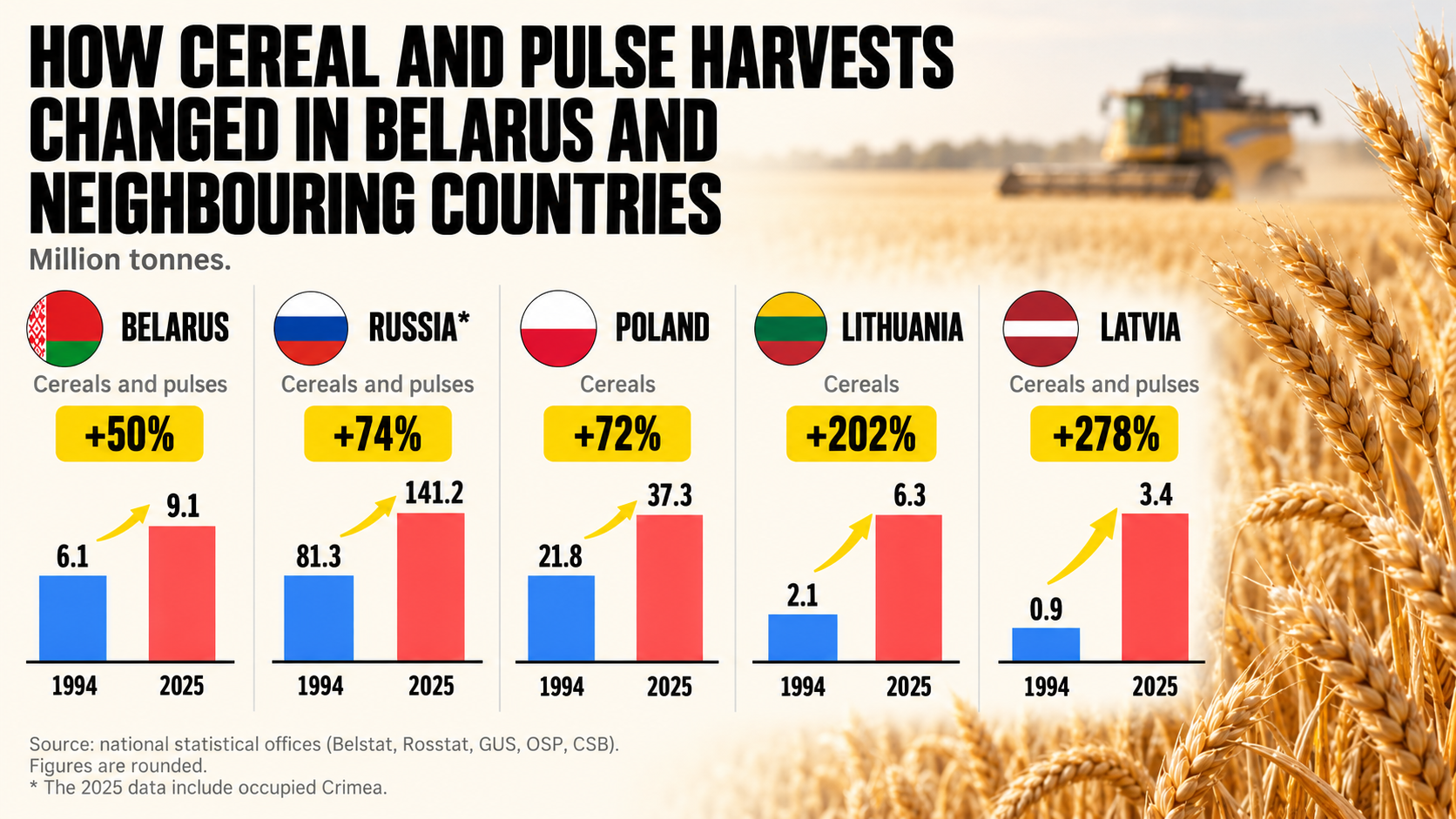
However, Belarus harvested significantly more grain in 1994 than Tur claimed. According to Belstat data, the total gross harvest of grain and legume crops was 6.095 million metric tons. The year before that, it was even higher at 7.508 million metric tons.
However, there’s another issue with the 2025 figure. The Ministry of Agriculture and Food reported a harvest of over 11 million metric tons. However, that figure included rapeseed and corn. Since rapeseed is an oilseed crop, it is incorrect to include it in a comparison of grain and legume harvests. According to Belstat data, farmers harvested just over 9 million metric tons of grain and legumes in 2025. That was about 1.5 times the 1994 figure—an increase of roughly 50%.
To evaluate the results within a regional context, the WTF team compared changes in harvest volumes from 1994 to 2025 in neighboring countries. Importantly, the indicator composition varies. For Russia, Latvia, and Belarus, both grains and legumes are included. For Poland and Lithuania, only grains are included.
According to Rosstat, Russia’s harvest of grains and legumes increased from 81.297 million to approximately 141.15 million metric tons — a 73.6% increase.
According to data from Statistics Poland, Poland’s grain harvest rose 71.6%, from 21.763 million to 37.335 million metric tons.
During the same period, the grain harvest in Lithuania rose roughly threefold, from 2.098 million to 6.334 million metric tons.
In Latvia, grain and legume production rose from 900,600 to 3,404,000 metric tons — about 3.8 times the 1994 level. As the country’s statistical office notes, legumes are included in the grain figure in the 1994 data.