


The Belarusian Investigative Center uncovered at least 20 real estate properties in occupied Crimea that were acquired after Russia’s annexation by companies linked to the business network of Viktar Sheiman, a long-time ally of Aleksandr Lukashenko. The assets include properties in Alushta, Simferopol, Sevastopol, Dzhankoi and Kerch, as well as 13 apartments in Yalta’s Respect Hall apart-hotel complex. By 2022, their estimated value exceeded €2 million.
BIC traced several ownership chains showing how properties in Alushta and Simferopol once owned by Ukrainian banks passed through different companies, including Scholz-Trans, Malbork and Arma, before ultimately ending up with First Investment Company (PIK), registered in Simferopol. The investigation links in the ownership chains to people and firms that had already appeared in previous BIC investigations into Sheiman’s business empire, including Vector Capital Group, the Cypriot companies Dimicandum and Rostumel, former Sheiman deputy Andrei Sviridov, Dzmitry Varaksa, and Katsyaryna Karniyenka.
After Russia's full-scale invasion of Ukraine, the scheme backfired. PIK was owned by the Cyprus-registered Rostumel, and after Cyprus was designated by Russia as an "unfriendly state," Crimean authorities began nationalizing property owned by companies from such jurisdictions. As a result, PIK's assets were nationalized.
The investigation shows that attempts to save the properties failed. First, ownership of PIK was transferred to a Crimean lawyer Irina Nanikashvili. Later, two other companies tried to prove that they had purchased some of the properties before the nationalization decree. PIK's lawyers then challenged the nationalization decree in court. Time and again, the occupation courts sided with the occupation authorities. BIC counted 16 unsuccessful lawsuits seeking recognition of ownership rights. An expert interviewed by BIC said that the chances of recovering the assets are extremely low.
The annexation of Crimea enabled individuals with ties to the Belarusian authorities to acquire real estate on the peninsula. They took advantage of the situation: the new administration seized apartments, commercial premises, and hotel apartments owned by Ukrainian banks, then put them up for sale. Following Russia’s full-scale invasion of Ukraine and the subsequent imposition of Western sanctions, luck turned against the new owners — the purchased assets were nationalized.
Journalists from the Belarusian Investigative Center uncovered at least 20 assets in Crimea acquired by companies linked to the entourage of Viktar Sheiman, one of Aleksandr Lukashenko’s closest associates. These include properties in Alushta, Simferopol, and Sevastopol, as well as in Dzhankoi, Kerch, and Yalta. Different companies owned this real estate at different times, but by the end of 2022, all the properties were transferred to the Simferopol-registered OOO Pervaya Investitsionnaya Kompaniya (hereinafter, “PIK”). As in our previous investigations, subjects transferred assets from one firm to another, making it difficult to identify the ultimate beneficiaries. However, the same individuals appeared in different structures at various stages.
“Crimea has become an unattractive territory for investment after 2014. Of course, given that all types of sanctions apply to it… On the other hand, it is a very attractive land for those who would like to launder their dirty money, conceal assets acquired through not entirely legal or even outright criminal means. Therefore, Crimea has turned into a kind of grey zone where many financial monitoring mechanisms are inaccessible,” Valentyna Samar, editor-in-chief of the Crimean Center of Journalistic Investigations, told the Belarusian Investigative Center.
Sheiman’s shadow
Before being transferred to PIK, two properties had passed through two owners. One is located in Alushta — a more than 100-square-meter premises in the center of the resort city, within a ten-minute walk of the waterfront. The other is situated in Simferopol, in a non-residential section of a building in the center of the Crimean capital. At the end of 2020, TzOV Scholz-Trans became the new owner of these properties, which had previously belonged to Ukrainian banks. The company was registered in Ukraine by Maria Nazarkevich. [*] [*] Her husband, businessman Vitalii Bobyr, and his mother, Iryna Bobyr, were both featured in a BIC investigation into a sanctions evasion scheme involving the sale of luxury cars. We then found several indirect links between them and Viktar Sheiman. [*]
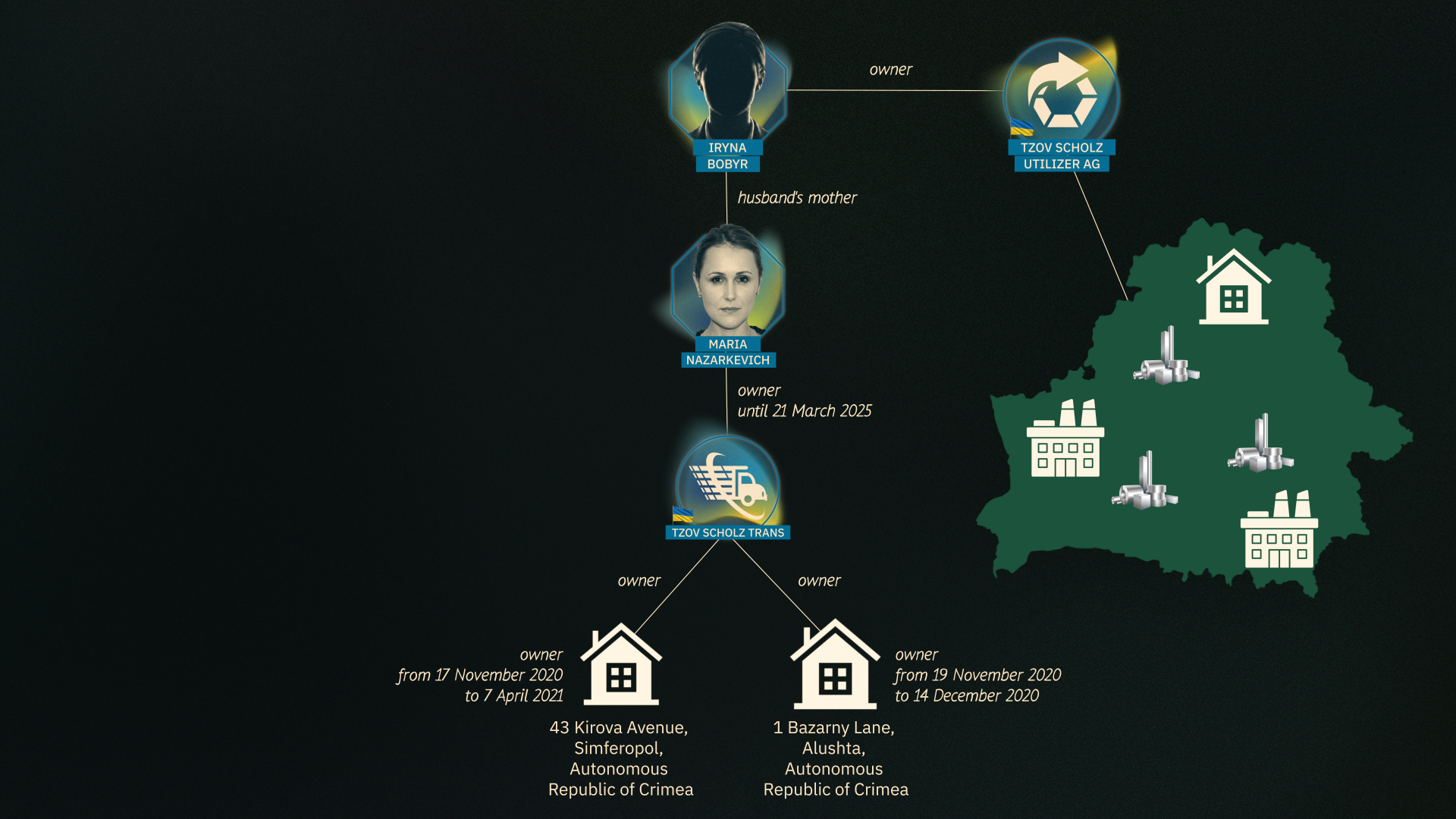
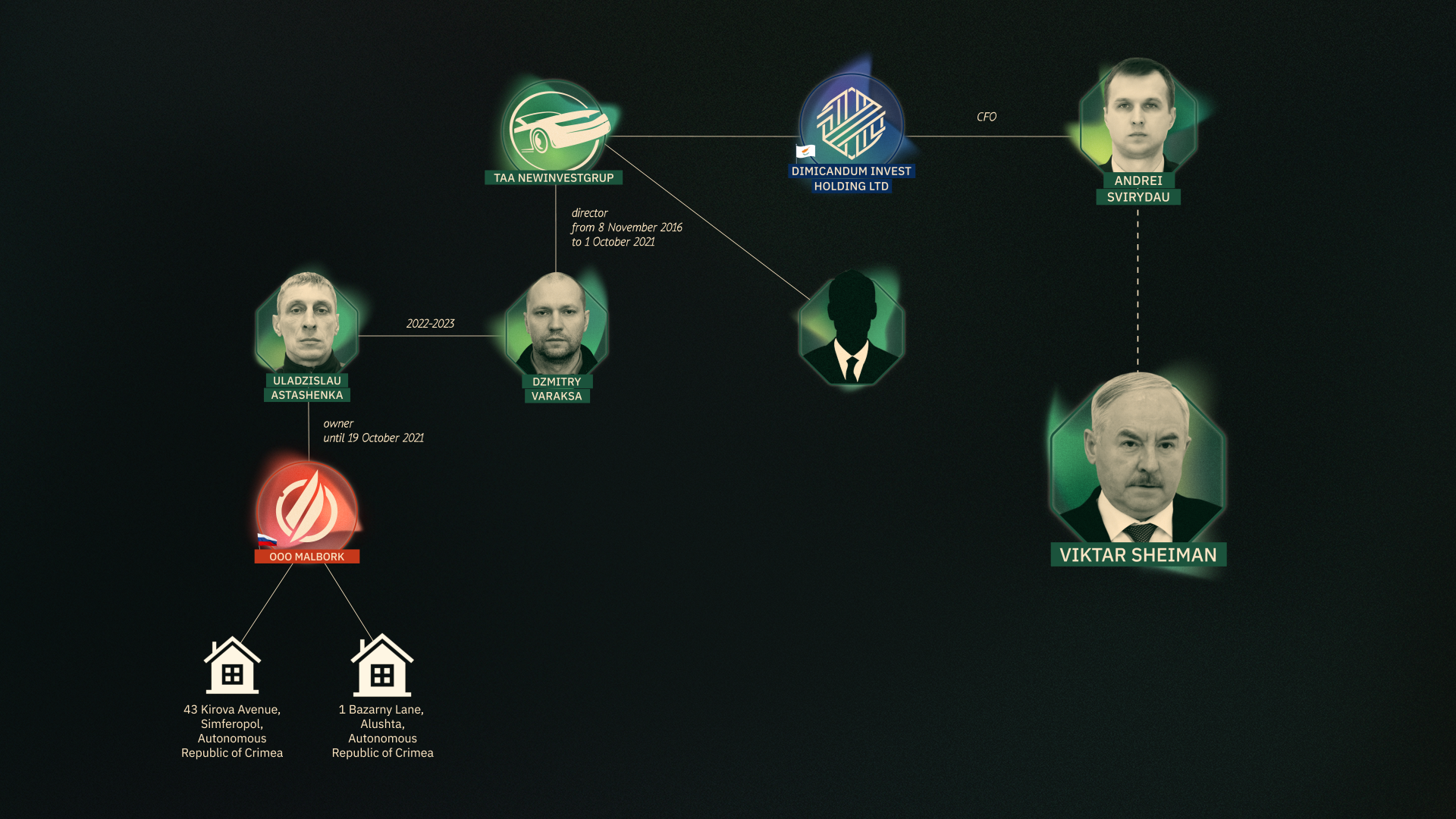
In the span of a year, the assets in Alushta and Simferopol were transferred to OOO Malbork, a Moscow-based entity. At that time, the company’s director and owner was Uladzislau Astashenka, a Belarusian. [*] [*] According to the data provided by CyberPartisans, he identified Dzmitry Varaksa — the former director of the Belarusian company TAA NewInvestGrup — as his employer. The company is partly owned by the Cyprus-based Dimicandum Invest Holding LTD (hereafter, “Dimicandum”), [*] [*] which was previously implicated in a scheme involving the sale of Belarusian potash at inflated prices and the circumvention of sanctions. Andrei Svirydau, a former deputy of Viktar Sheiman at the Presidential Property Management Department, has been the financial director of this Cypriot firm at least in 2022-2023.
Svirydau is also a co-founder and, until February 2024, the director of Sheiman’s shadow business empire,
ZAT Vector Capital Group. He has been implicated in the BIC’s investigation into the circumvention of sanctions imposed on Belaruskali.
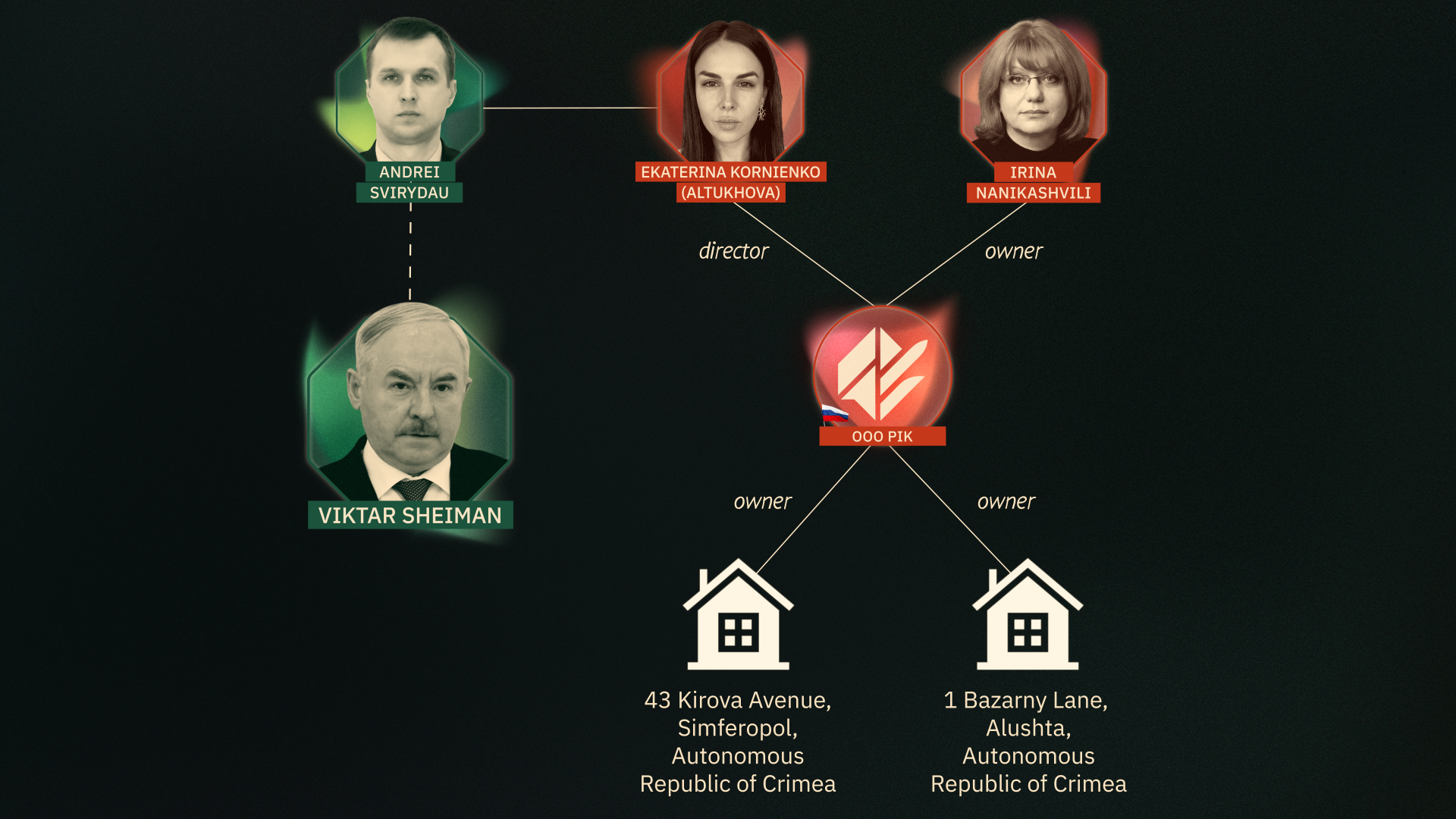
PIK took ownership of the premises in Alushta and Simferopol in March and November 2021.
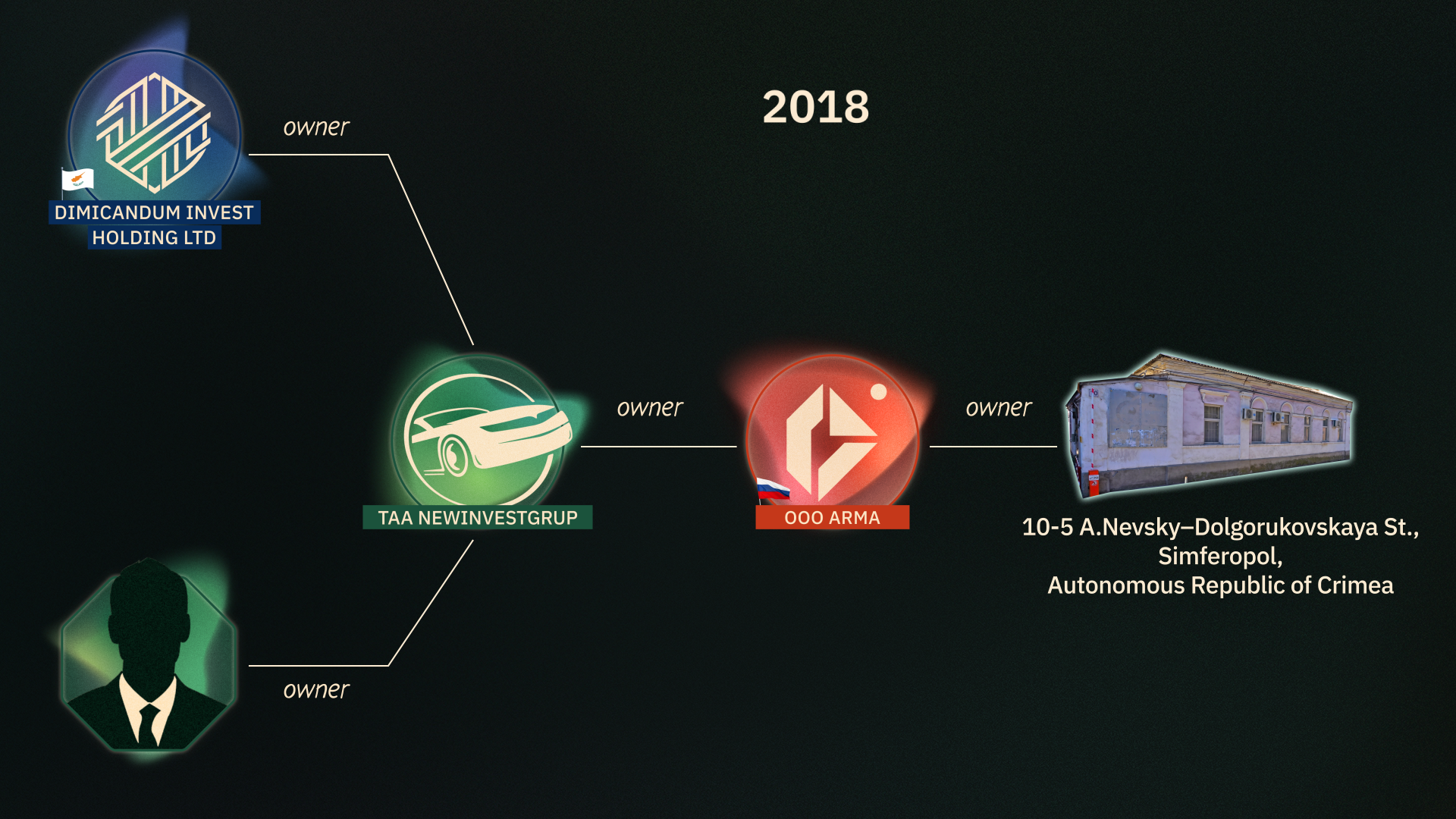
The ownership of another property changed in a similar manner — premises of 1,700-square-meter in the center of Simferopol. In 2018, the former asset of a Ukrainian bank was acquired by OOO Arma. At that time, the company was owned by NewInvestGrup [*] [*] which we mentioned earlier when describing the chain of transfers involving properties in Alushta and Simferopol. In 2019, PIK took ownership of the property.
In November 2022, PIK also acquired ownership of 13 residential apartments in the prestigious Respect Hall apart-hotel complex in Yalta.
The same people
As of 2022, PIK owned Crimean real estate with an aggregate value of more than €2 million. From April 2019 to October 2022, the company was owned by Rostumel Holding Limited (hereinafter, “Rostumel”), a Cyprus-based firm. [*] [*] This firm has been the subject of several BIC investigations. In one of these investigations, we proved that the firm issued an indirect loan for the construction of Aleksandr Lukashenko’s alleged private chalet near Sochi.

From mid-2024 until the end of 2025, the financial director of Rostumel was Andrei Svirydau, whom we previously mentioned in the same role at the Cypriot company Dimicandum. [*] Ekaterina Kornienko (married name Altukhova), his business partner and a Crimean with a Russian passport, is listed as the director of PIK. [*] Not only are they involved in the Crimean real estate scheme together, but they also run a joint company, OOO Astrata, which is registered in Russia. Through this company, they supplied sanctioned cars from the European Union to Russia via Belarus. [*] [*] [*]
We called Ekaterina Kornienko to ask her when and under what circumstances she became the director of Pervaya Investitsionnaya Kompaniya. After the journalist introduced himself and said he was calling about PIK, she began shouting before he could ask a single question:
“Who are you, and why are you calling me?! Forget this number! If I see you calling again, I’ll go straight to the police. Then we’ll conduct an investigation and find out why you’re calling my number!”
After that, the PIK director hung up. The conversation with Andrei Svirydau ended the same way. We could not reach any of the other individuals named in this investigation, except for Dzmitry Varaksa, the ex-director of NewInvestGrup. He claimed to know nothing about transactions involving Crimean real estate.
On the “unfriendly states” list
The annexation of Crimea allowed people connected with the Belarusian authorities to acquire real estate on the peninsula. However, the legal chaos that ensued after the start of the full-scale war prevented them from keeping it.
The European Union immediately imposed sanctions against Russia over its attack on Ukraine. In response in March 2022, Vladimir Putin approved a special procedure for fulfilling obligations to entities from unfriendly states. The Russian government included all EU countries on this list. Based on these decisions, the Crimean authorities issued a decree authorizing the confiscation of property owned by residents of countries designated as “unfriendly.” Pervaya Investitsionnaya Kompaniya’s assets on the peninsula were jeopardized because its parent company, Rostumel, is registered in Cyprus, which is a member of the European Union.
A BIC journalist posed as a representative of a potential investor and contacted PIK’s lawyer, Irina Nanikashvili, to find out what was happening with the company’s Crimean property. She said that the local authorities have seized and sold almost all of the properties:
“As far as I know, they [properties in Respect Hall — ed. note] were transferred into state ownership, under the control of the FSB border service. <...> As of today, 90% of the properties have been sold, while we are trying in court to recover them because we believe they were nationalized without sufficient legal grounds,” Nanikashvili explained.
An ineffective strategy
Irina Nanikashvili was involved in the early attempt to protect the company’s real estate assets in Crimea. Three days after the nationalisation decree came into force, the Cypriot company Rostumel transferred control of PIK to the Crimean lawyer. [*] They probably hoped that, as a Russian citizen, would not fall under the decree, unlike a company registered in an “unfriendly” jurisdiction. However, this did not help. On February 3, 2023, the properties in Alushta, Simferopol, Sevastopol, Dzhankoi, and Kerch were nationalized. [*] [*]
A few days later, on February 7 and 9, two companies filed suit, claiming they had purchased the selected assets from PIK prior to the nationalization. [*] [*] [*] [*] One of them, OOO Simeks, belongs to the Belarusian TAA Bel-Bitfinder. [*] [*] It appeared in the BIC investigation as a participant in the scheme to illegally import luxury cars to Russia through Belarus. It is assumed that Viktar Sheiman made money from this scheme. The second is OOO Gyurgi. The company’s CEO was Irina Nanikashvili, the Crimean lawyer who became the owner of PIK after the Cypriot company Rostumel. The court rejected the claims filed by Simeks and Gyurgi against PIK.
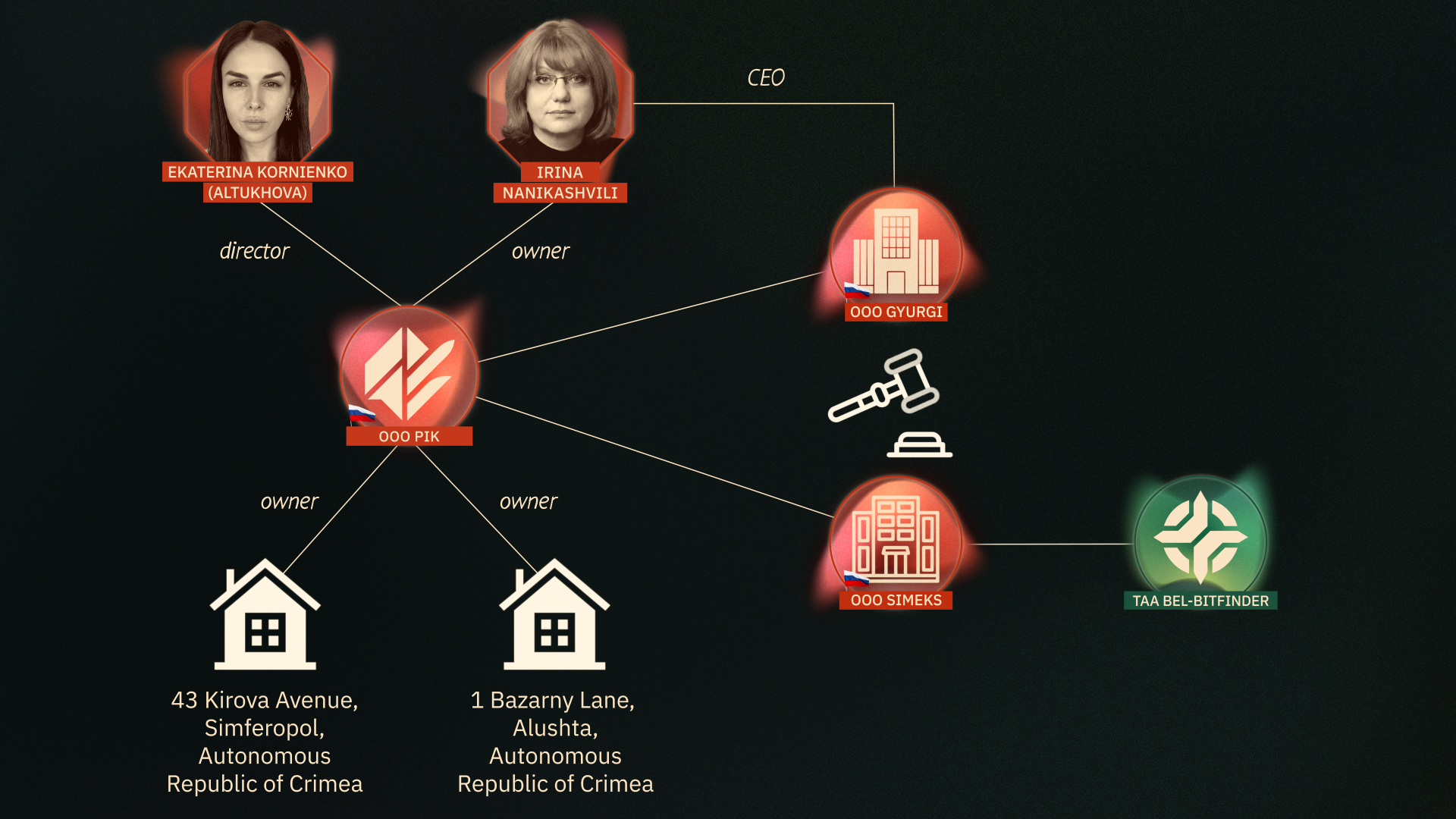
Following two failed attempts to recover the property, PIK altered its strategy. The company tried to challenge the legality of the Crimean authorities’ nationalization decree. The lawyers argued that the contested decree of the State Council of the Republic of Crimea did not comply with the requirements of federal legislation. Even in this case, however, the arbitration court sided with the occupation administration, ruling that the regional authorities have the right to adopt their own regulations.
“Goodbye, gentlemen”
Courts have already examined 16 lawsuits filed by PIK seeking recognition of ownership rights to the seized properties. Time and again, the company’s appeals have been denied. Most likely, at the outset, “there was a lack of clarity about who the real beneficiary was,” and “the presence of Viktar Sheiman behind these Cypriot companies was not sufficiently articulated or distinctly visible,” suggested Ilia Shumanov, Managing Partner at TriTrace Investigations, in a comment to the Belarusian Investigative Center. The property may be challenging to regain after three years, according to the expert:
“If it is entered into the property register, there is essentially no way back from it. There have been no precedents of them [the Crimean authorities — ed. note] removing such property from the register. <...> They [lawyers of PIK] may try to change the grounds for filing a claim, adjust their approach, or find a different legal argument regarding alleged violations of legislation, but they cannot file again on the same basis. In other words, they cannot challenge the non-regulatory act, because there is already a court ruling in place, they cannot [contest] the illegality of the authorities’ actions.”
According to Ilia Shumanov, even if Viktar Sheiman makes a deal with the Prosecutor General of the Russian Federation, Aleksandr Gutsan, the outcome is unlikely to be positive. This is “because they have already lost so many suits, and a prejudicial decision has been made that says, ‘No, this property was legally seized. Goodbye, gentlemen from PIK.’”




![[*]](/storage/page_blocks/May2026/114.png)
![[*]](/storage/page_blocks/May2026/27.png)
![[*]](/storage/page_blocks/May2026/38.png)
![[*]](/storage/page_blocks/May2026/47.png)
![[*]](/storage/page_blocks/May2026/52.png)
![[*]](/storage/page_blocks/May2026/62.png)
![[*]](/storage/page_blocks/May2026/72.png)
![[*]](/storage/page_blocks/May2026/92.png)
![[*]](/storage/page_blocks/May2026/102.png)
![[*]](/storage/page_blocks/May2026/116.png)
![[*]](/storage/page_blocks/May2026/126.png)
![[*]](/storage/page_blocks/May2026/135.png)
![[*]](/storage/page_blocks/May2026/145.png)
![[*]](/storage/page_blocks/May2026/153.png)
![[*]](/storage/page_blocks/May2026/162.png)
![[*]](/storage/page_blocks/May2026/172.png)
![[*]](/storage/page_blocks/May2026/16а2.png)
![[*]](/storage/page_blocks/May2026/182.png)
![[*]](/storage/page_blocks/May2026/192.png)
![[*]](/storage/page_blocks/May2026/201.png)
![[*]](/storage/page_blocks/May2026/212.png)
![[*]](/storage/page_blocks/May2026/222.png)
![[*]](/storage/page_blocks/May2026/232.png)
![[*]](/storage/page_blocks/May2026/243.png)
![[*]](/storage/page_blocks/May2026/252.png)