We investigate corruption, uncover fake news and analyze the news agenda. The BIC is a member of the global network of investigative journalists.
Our journalists have received theHans Staiger Investigative Award from the International Center for Journalists; the Free Media Award from the ZEIT-Stiftung Bucerius and the Fritt Ord Foundation; and the Data Journalism Award from the Society for Advancing Business Editing and Writing. Our Dubai Unlocked project was also shortlisted for the Sigma Awards.
Between 2018 and 2026, our journalists received 11 Belarusian Volnaye Slova Awards.
BIC is a member of the OCCRP (Organized Crime and Corruption Reporting Project)
We are also members of GIJN (Global Investigative Journalism Network)
Azaronak claimed that Belarusians and Westerners have “completely different values.” Here is what the surveys show
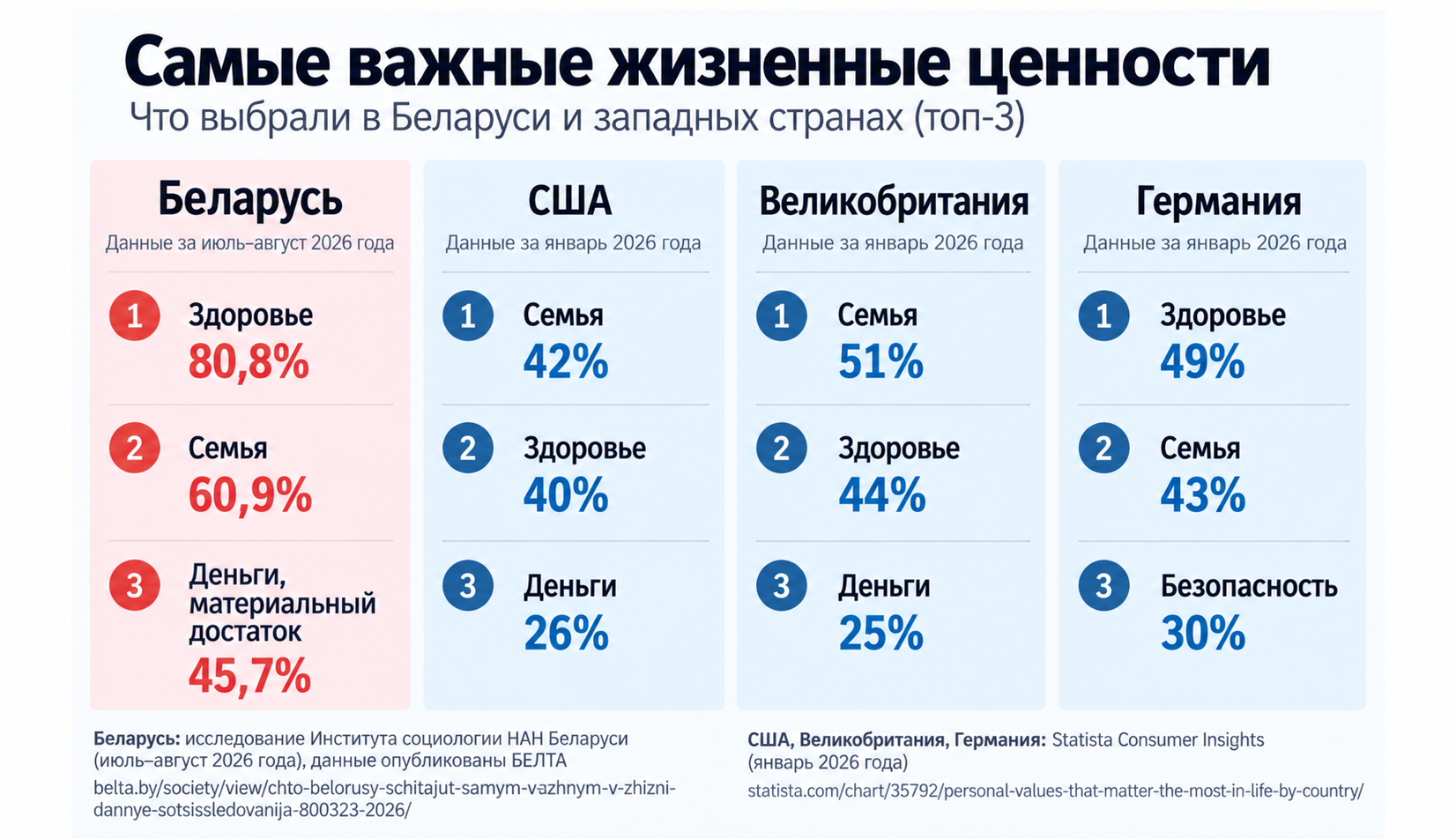
In Belarus, as well as in the U.S. and the U.K., family, health, and money were among the top values.
Host Ryhor Azaronak presented the results of a survey of Belarusians as evidence that their values are completely different from those of people in Western countries. However, he did not cite the Western survey whose results he referenced, and data from other studies do not support his conclusion.
Context: In September 2026, the Institute of Sociology at the National Academy of Sciences of Belarus presented the results of a survey of over 2,000 of the country’s residents. Among other things, they were asked about their financial situation and life priorities.
On September 14, 2026, Ryhor Azaronak, the host of Azaryonok. Napryamuyu, discussed the survey results. He listed the life priorities cited by Belarusians and then contrasted them with the values of people in Western countries.
“Similar opinion polls have been conducted in the West. There, personal rights and freedoms, comfort, and self-fulfillment are the top three priorities. Here, it’s health, family, and, well, material well-being. … In other words, our values are completely different from those in the West.”
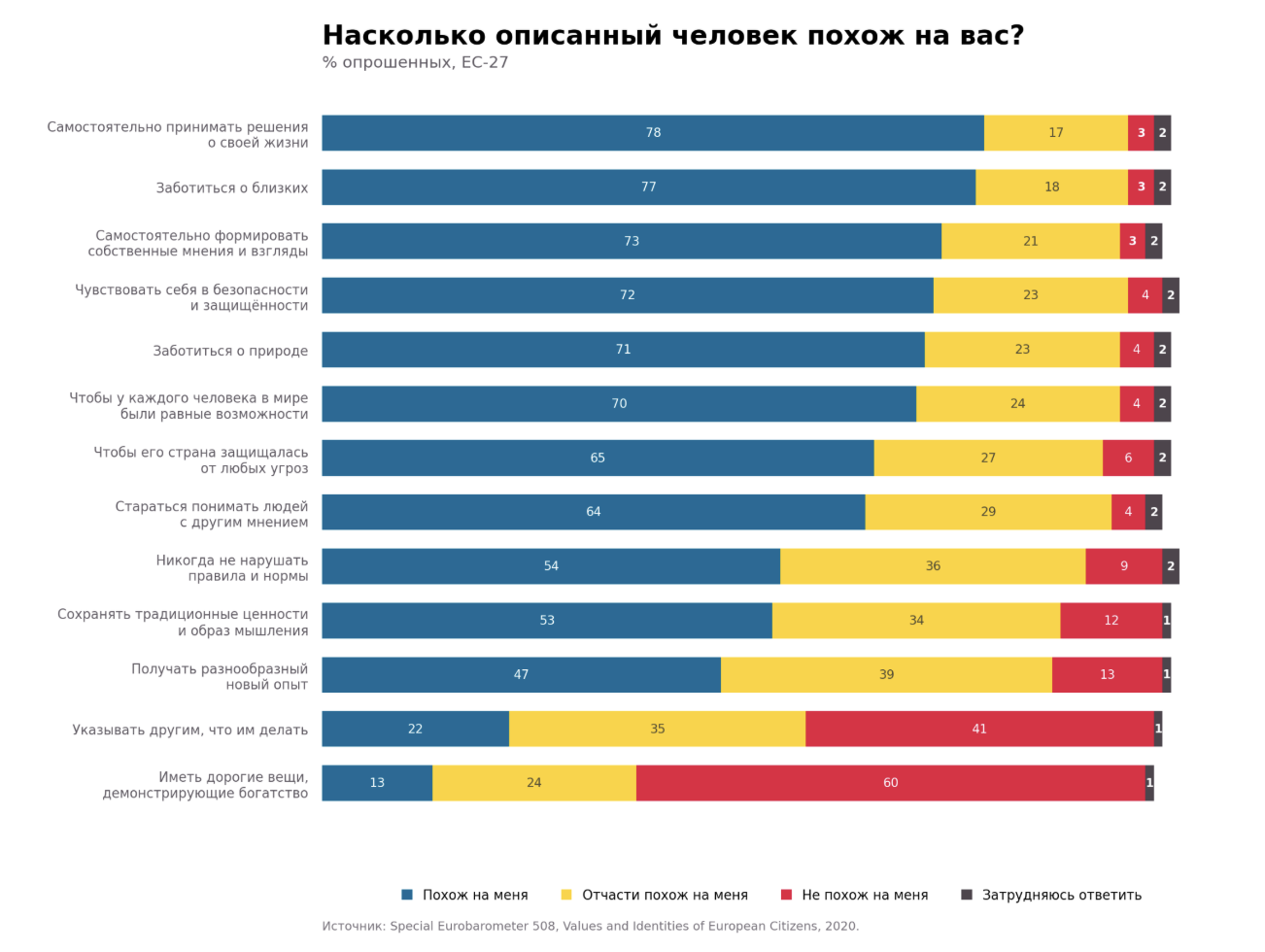
The Weekly Top Fake team could not identify the survey of Western residents that produced this exact top three. A related Eurobarometer survey was conducted differently. Participants were asked to choose the most important option from among thirteen predefined choices. Caring for loved ones, an option closely related to family, ranked second. “Health” and “love” were not among the suggested answers. Therefore, differences in lists of answers do not necessarily indicate different values.
A survey with a more closely matching question was conducted by Statista Consumer Insights in January 2026. People in the United States, the United Kingdom, and Germany were asked to choose the three most important aspects of life. In both the U.S. and the U.K., family, health, and money were the most frequently cited values, which are the same ones identified by Azaronak in the Belarusian survey. In Germany, health, family, and safety ranked among the top three priorities.
These surveys do not support the claim that the life values of Belarusians and Westerners are “completely different.” At least the health and family values cited by Azaronak are also important to respondents in Western countries.
The political scientist cited a figure of 10–15%. In an international survey, 37% of European respondents aged 18 to 55 expressed a willingness to fight.
Following indexation, pensions have increased at a faster rate than inflation. Contributions to NATO’s common budgets amount to approximately 0.05% of total state expenditures.