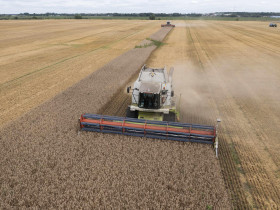


Context: During a July 21 conference call regarding the 2026 harvest campaign, Aleksandr Lukashenko said that disorder, alcohol abuse, and theft during the harvest are unacceptable. He also ordered that anyone who performed poorly during the harvesting operations be sent to the forest along the border with Ukraine for re-education in the army.
On July 21, 2026, during an episode of the talk show Budni on Alpha Radio and SBTV, political scientist and history Ph.D. Aliaksei Bialiajeu stated that Belarusian agriculture had become so efficient that crop yields nearly doubled this year.
“We’re observing growth. As we can see, crop yields are increasing. In fact, by many measures, they have already reached 1.8 times last year’s level. In terms of grain yield per hectare. Isn’t that wonderful? 1.8 times — can you imagine? We’re just a little short of doubling our yield with the same production capacity,” Bialiayeu said.
That’s not true, though. On July 20, the Ministry of Agriculture and Food reported that this year’s yield was only 1.8 centners per hectare higher than during the same period last year. In other words, it was not a 1.8-fold increase, but rather an increase of 1.8 centners per hectare. In later statements, however, the ministry no longer claimed that crop yields had increased. Instead, it said they had remained at the previous year’s level.
The day before the Budni show, Iryna Novikava, Ph.D. in Economics and professor, had also raised the topic of the efficiency of Belarusian agriculture. During the July 20, 2026 episode of the radio show Ekspertnyi Klub on the First National Channel of Belarusian Radio, she stated that Lithuania is not ahead of Belarus in terms of wheat yields.
“When they said that more wheat had been harvested in Lithuania — we talked about it — they included corn and other crops in that figure. Actually, the wheat yield per hectare was the same, according to my calculations. There’s just a slight difference of 2–3 kg, so it’s practically the same. So our agriculture is indeed efficient,” said Novikava.
Previously, Novikava had made an inaccurate comparison of the two countries’ agricultural sectors. To calculate the wheat harvest per hectare, she divided the total output of rye, wheat, barley, and other grains and legumes by the total area of arable land in the country.
A different picture emerges, however, when we look specifically at wheat yields. According to official data, Belarusian farmers harvested 36 centners of winter wheat per hectare in 2021, while Lithuanian farmers harvested 12 centners more. Winter wheat makes up most of the wheat harvest in both Belarus and Lithuania.
Directly comparing the results with those from last year is more difficult because Belstat has only been publishing the combined yield of winter and spring wheat since then. Last year, the total yield was 41 centners per hectare. The yield for winter wheat alone will be marginally higher, but it still won’t surpass Lithuania’s yield of over 55 centners per hectare. In other words, the difference between Lithuania and Belarus is more than 1,000 kg per hectare, not 2–3 kg as Novikava claimed.
Lithuania significantly outpaces Belarus when all cereals and grain legumes are considered together — by hundreds of kilograms per hectare.