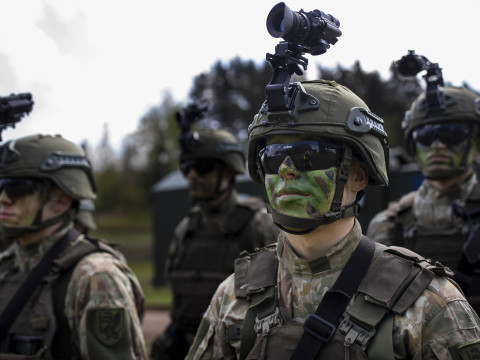


Context: In an interview with the Swiss newspaper Neue Zürcher Zeitung on May 18, 2026, the Lithuanian Foreign Minister stated that, NATO has the capability in the Baltic region, if necessary, to strike Kaliningrad and raze Russian air-defense and missile bases there to the ground. In response, Vladimir Putin said that the Russian Federation has the means to destroy anyone who tries to do so.
On May 22, 2026, Andrey Bogodel, a military expert, appeared on Radio-Minsk and responded to the Lithuanian Foreign Minister’s statement, saying that the Baltic countries owe their literacy to the Russians.
“Nobody cared about this Baltic region for a thousand years. It has always been important to us, though. Not because we wanted to exploit it, but because, I have to say it, people in the Baltic region became literate thanks to the Russians who arrived there in 1940 and liberated them from that oppressor, Smetona.”
This statement does not align with the facts. The population of the Baltic States was already mostly literate by the time Soviet troops occupied the region. According to the 1922 census, 88% of Estonian residents aged 15 and over could read and write. In Latvia, the census was held in 1925. At that time, 85% of the residents were already literate. The figures were lower in Lithuania, but by 1941, nine out of ten people could read, and seven out of ten could read and write.
Furthermore, these peoples were among the most literate in the Russian Empire. The first All-Russian population census, conducted 20 years before the October Revolution, showed that the literacy rate in Tsarist Russia was 20%. In the Moscow Province, it was 40%. Meanwhile, the census recorded a 70% literacy rate in the Courland province, which is now part of modern-day Latvia. The Estland province, now part of modern-day Estonia, had an 80% literacy rate.
The reason was not the beneficial influence of the Russians but, in many ways, religion. Protestantism is widespread in Latvia and Estonia. For Protestants, it is important to be able to read the Bible independently.
Therefore, Bogodel’s statement is a reversal of historical reality. Even before the advent of Soviet power, the inhabitants of Latvia and Estonia were significantly more literate than the Russian Empire’s population. Therefore, the claim that the Russians brought literacy to the Baltic States in 1940 is not true.