

This is a major BIC investigation revealing how a Belarusian cookware factory in Gomel became a key link in the supply chain of drones for the Russian army.
From Pots to Combat Drones
Zavod Santex in Gomel officially produces enamelware, sinks, and trash bins. But behind this peaceful facade lies a large-scale business re-exporting drones to Russia. In 2022-2023, the factory sold 309 drones from Chinese companies DJI and Autel to Russia worth $2 million, helping circumvent sanctions.
The Belarusian Baron of Russian Drones
The factory owner is Minsk-born Pavel Nikitin, who moved to Russia in the 2000s. He owns 95% of the Russian company OOO Rustakt — one of the largest manufacturers of kamikaze combat drones for the Russian army.
The Scale is Staggering:
- In 2023-2024, Rustakt received $1.12 billion in contracts with Russian military organizations
- Over three years, the company purchased 3.5 million electric motors from China for $90 million — enough to assemble 870,000 copters
- Rustakt transferred over $152 million to Zavod Santex for unspecified "equipment"
The "Doomsday" Drone
Rustakt produces one of the most mass-produced Russian kamikaze drones — the PVH-1 (VT-40), known as "Sudoplatov." This is the primary weapon of the elite unmanned technology center "Rubicon," which, according to Ukrainian military sources, has unlimited financial resources.
Rustakt's Clients:
- GRU (The "Military Unit 45807")
- 18th Central Research Institute of the Russian Ministry of Defense (The FGUP “18 TSNII” MA RF)
- Charity Fund “People's Front. Everything for the Victory”
- JSC “RPA Obukhovsky Plant" (Almaz-Antey Concern)
The investigation shows that Belarus has become a reliable channel for sanctions evasion, allowing Russia to obtain critically important components for war. This is the second part of BIC's major investigation into how Belarusian companies help Russia wage war against Ukraine while circumventing international sanctions.
The Homel cookware plant Zavod Santex runs a hidden business: pots and pans on display, combat drones under the counter. Its owner rose from being a major supplier to Russia’s security services to what appears to be one of the Kremlin’s principal vendors of kamikaze drones.
A BIC investigation reveals how, behind the facade of a civilian enterprise, an infrastructure of war has taken shape — enabling Moscow to keep attacking Ukraine despite sanctions. This is the second part of the story about how Belarusian firms circumvent restrictions and sell drones to Russia. It was prepared with the support of the CyberPartisans.
Pans, pots, trash cans and drones
In the Soviet District of Homel, Belarus’s second-largest city, stands a factory with a century of history. Once known for producing cast-iron cookware during the Soviet era, the plant was privatized after Belarus gained independence and now operates under the brand name Zavod Santex. On its website, the company presents a familiar catalog of utilitarian goods: metal pots and pans, buckets, and trash containers.
Yet in June 2025, a different item appeared among the listings — a quadcopter called Pioneer. Marketed as “a compact and productive quadcopter designed for real-time video monitoring” the description emphasized that such models were recommended by Russia’s Ministry of Education for use in classrooms teaching secondary vocational programs on unmanned aircraft systems. By late 2025, references to the Pioneer drone had disappeared from the company’s site, though they remain preserved in archived versions.
To determine whether the factory’s public profile reflects its actual business, journalists from the Belarusian Investigative Center examined customs records. The documents revealed that Zavod Santex had re-exported Сhinese drones manufactured by DJI and Autel to Russia, after China stopped direct sales to this country. In 2022 and 2023 alone, the company shipped 309 drones worth a total of $2 million. The findings suggest that the Belarusian enterprise played a role in helping Russian firms circumvent restrictions on civilian quadcopter supplies.
The Russian buyers of the drones were two companies: OOO Santross and OOO Rustakt. The latter has been under EU and Swiss sanctions since December 2024. Public records and media reports identify ООО Rustakt as one of the country’s central hubs for assembling so‑called kamikaze drones used by the Russian military. Zavod Santex, which shipped drones to Russia, and both Russian companies that received them are owned by the same person — Pavel Nikitsin (Nikitin), a native of Belarus.
Drones of the “Judgement Day”
The Main Directorate of Intelligence of the Ministry of Defense of Ukraine describes ООО Rustakt as the manufacturer and seller of one of the most mass-produced Russian FPV-kamikaze drones – PVC-1, also named VT-40, or drone of the Judgement Day-Sudoplatov, by the name of the project to manufacture such drones. The Judgement Day project also includes the training of pilots for the Russian war against Ukraine. The VT-40 has emerged as the primary combat drone of Rubikon, a secretive Russian military center dedicated to advanced unmanned technologies. Formed in August 2024, Rubikon squads have quickly gained a reputation among Ukrainian and international analysts as one of the most effective forces in Moscow’s drone war.

Ukrainian sources credit Rubikon with playing a decisive role in the counteroffensive that retook parts of the Kursk region in the spring of 2025, as well as in the capture of Pokrovsk that autumn.
“VT‑40 is one of Russia’s main FPV drones; it has been used many thousands of times and killed many Ukrainians. While inferior to its Ukrainian counterparts, it is still dangerous.” — said British journalist David Hambling, who specializes in military and technology reporting, in a comment to BIC.
OOO Rustakt as the Russian drone flagship
According to Vladimir Putin, Russia sent 1.5 million drones of all types in 2024 to be used in the war against Ukraine. The bulk of this number were FPV-copters, such as VT-40. One such drone requires 4 engines and dozens of electronic components.
The Wall Street Journal wrote on October 29, 2025, quoting confidential reports, that Rustakt bought 3.3 million engines from China for the total sum of $83 million in the years 2023-25. A source in the logistics sector has provided the BIC with documents that give us some additional figures and show the scale of the Rustakt drone business.
During the last three years Rustakt bought 3,472,360 electric engines for the total price of about $90 million from 3 Chinese companies: Shenzhen Minhuaxin Technology CO., LTD, Shenzhen Nasmin Technology CO.,LTD and Shenzhen Kiosk Electronic CO., LTD. This would be enough to use in 870,000 copters.
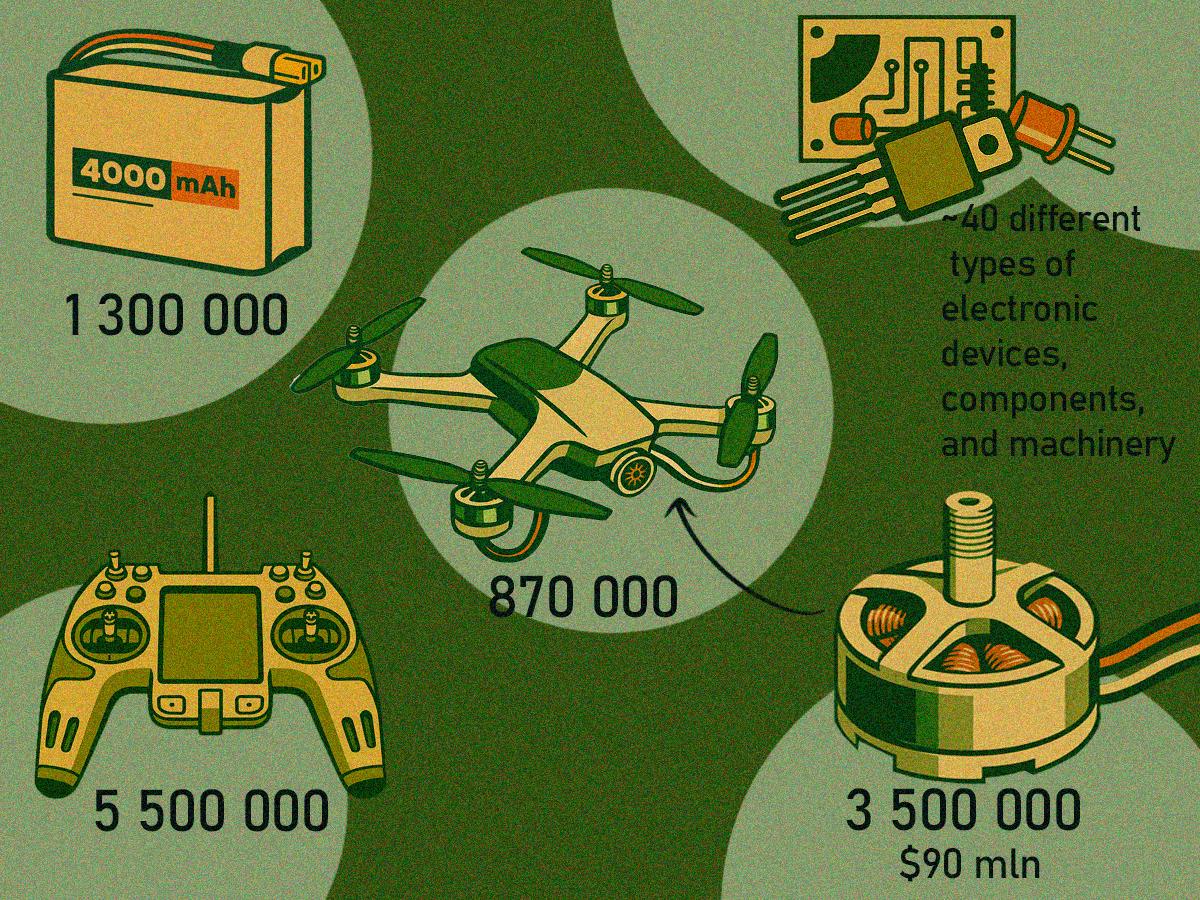
In addition, the BIC has found proof that OOO Rustakt purchased from China 1.3 million lithium-ion batteries, 5.5 million electronic components for radio-controlled models and about 40 other types of electronic components and machine-tools. The total sum of these purchases was $323 million.
“That sounds very much like the components that would be bought to assemble a large number of FPVs. Sudoplatov claim that most of their components are Russian but this may not be strictly accurate. I can’t see what else someone would buy millions of electric motors for” — David Hambling told BIC.
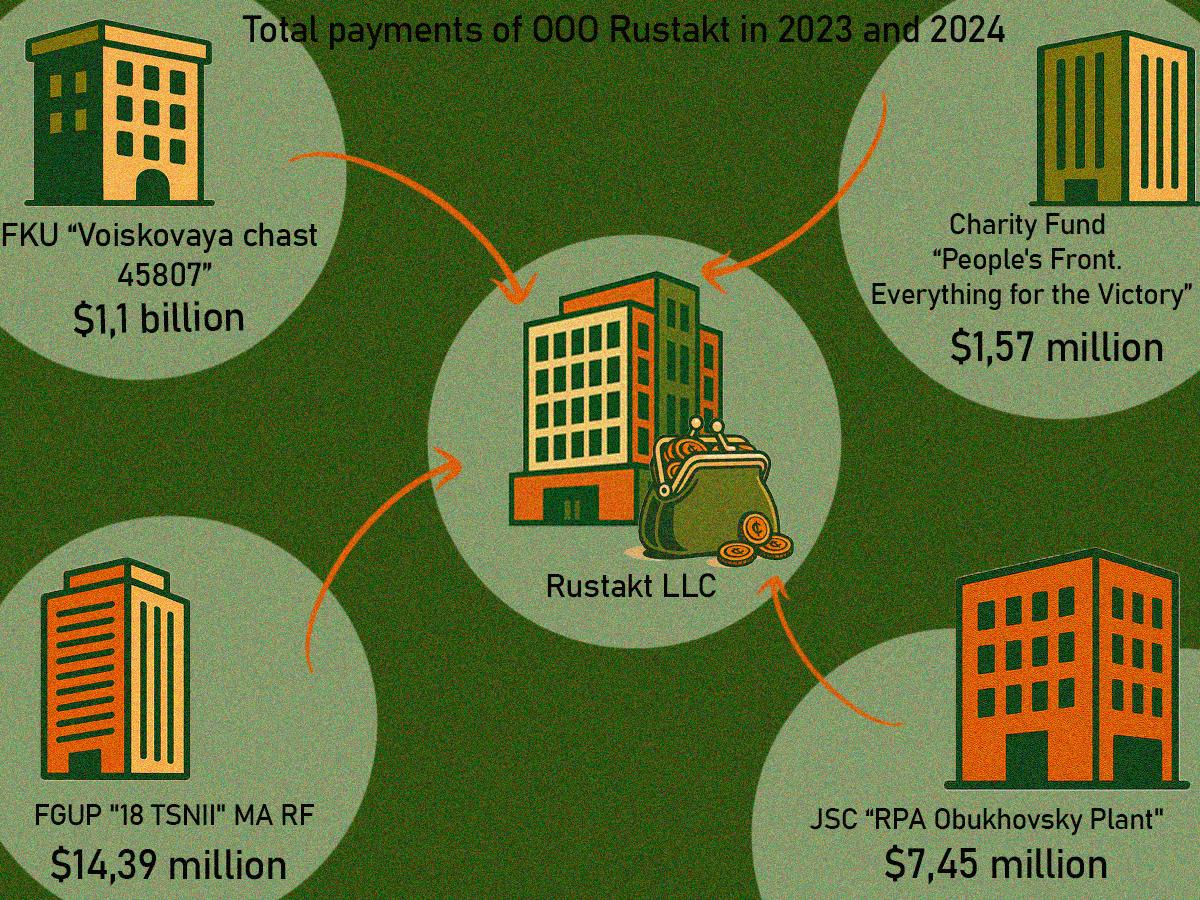
However, according to a source in Russia’s tax service, payments received by Rustakt from clients turned out to be almost three and a half times higher: during 2023 and 2024, just four organizations paid the company $1.12 billion for goods and services. All four are connected to the defense sector:
- The FKU “Voiskovaya chast 45807” (The “Military Unit 45807”), better known as the GRU, Russia’s military intelligence agency.
- The FGUP “18 TSNII” MA RF (The Federal State Unitary Enterprise "18th Central Research Institute" of the Russian Ministry of Defense) — it operates in support of the GRU and the General Staff.
- Charity Fund “People's Front. Everything for the Victory” — it is a private foundation that by July 2025 had collected more than $691 million in donations to support fighters of the so‑called Special Military Operation.
- JSC “RPA Obukhovsky Plant" — it makes air defence systems and light drones.
The Belarusian roots
The main owner of OOO Rustakt is Pavel Nikitsin (Nikitin). He was born in Minsk in 1977 and moved to Russia in the early 2000’s. During the last two decades Nikitsin has become the owner or co-owner of about 20 companies. About a dozen of them are still active.
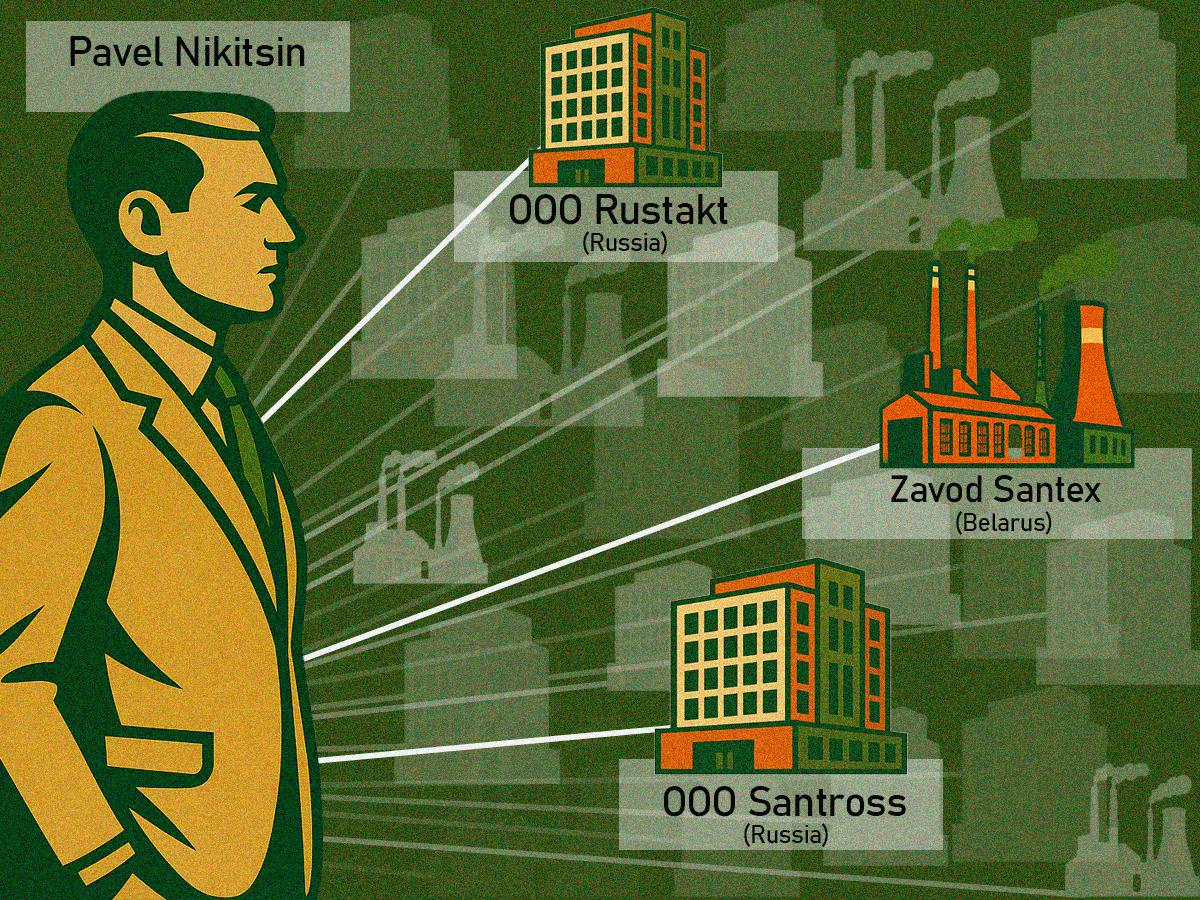
Nikitsin's businesses range from fishing to the assembly of combat kamikaze drones. OOO Rustakt is not his only company that has contracts with the Russian military or security forces. At least three of Nikitsin’s other companies have the Russian Ministry of Internal Affairs and Russia's National Guard as the main clients.
In 2010, Nikitsin withdrew from Belarusian citizenship, but he did not break ties with his country of birth. He or his relatives own or manage at least four companies in Belarus.
One of these companies is Zavod Santex in Homel, which re-exported Chinese drones to OOO Rustakt, as well as delivering undisclosed equipment valued at more than $150 million. The BIC has found a mention that in 2018 Zavod Santex was co-owned by Pavel Nikitsin’s twin brother Yagor Nikitsin, who was a citizen of Belarus as of 2021.
During a telephone conversation with a BIC journalist Yahor Nikitsin denied that he is one of the owners of the Homel-based factory: “You have simply false information. False.”
Pavel Nikitsin, the owner of Rustakt LLC, hung up the phone as soon as he heard the same question. Written inquiries to both brothers, as well as to the companies mentioned in this investigation, have remained unanswered.
Trusted ally
Both parts of the BIC investigation into drone supplies to Russia show that Belarusian firms have acted as a channel for circumventing restrictions on direct deliveries of Chinese drones to Russia since the first days of the war. According to our calculations, 14 companies in Belarus sold more than 20,000 drones to Russia between 2022 and 2025, with a total value of at least $34 million.
Sz DJI Technology CO., LTD, the Chinese manufacturer whose products Belarusian firms re‑exported to Russia, told BIC in a written response that it monitors its distributors and requires them to sign export‑control agreements. That assurance offers some hope that the flow of drones from Belarus to Russia may diminish.
Indeed, during the course of this investigation we found that one of the main official retailers of DJI drones in Minsk closed last year, while the largest Belarusian re‑exporter of DJI quadcopters stopped selling drones to Russia in April 2025. Still, in a phone conversation, a sales representative from that company offered to sell us drones made by another Chinese manufacturer — Autel.
Update 08.12.2025: Added information that Zavod Santex re-exported drones from the Chinese company Autel.